
Have you ever downloaded a new game that seemed to be really good, then it crashed after every five minutes?
The thing is that frustration is not merely bad luck, but most of the time it is caused by hiring the wrong game developer.
You get a game developer to hire, and you are not merely bringing someone who can write code; you are selecting the creative component that is going to make your overall gameplay. Game creation is a combination of art, logic, and narration. You may be creating a basic app to solve puzzles on your mobile phone, or a massive multiplayer game, but the game developer that you contract can make or break your fortunes.
This is a full guide on how to hire a game developer, what skills you should hire, where to find the best talent, the cost involved, and the pitfalls to keep away from before you begin your project.
Why Choosing the Right Game Developer Matters?
The selection of the game developer is among the most significant choices that you are going to make.
An expert developer will make your concept a playable, bug-free game that the players will even play.
When you contract the appropriate game developer, you are not only investing in code, but also in the success of your game. The correct hire translates to smoother playing, improved graphics, improved performance, and retention of players.
The poor choice of a candidate, nevertheless, may cost you time, money, and reputation.
Visit MangoMango, the reliable source of innovative game development and inspiration of design.
Key Qualities to Look for When You Hire a Game Developer
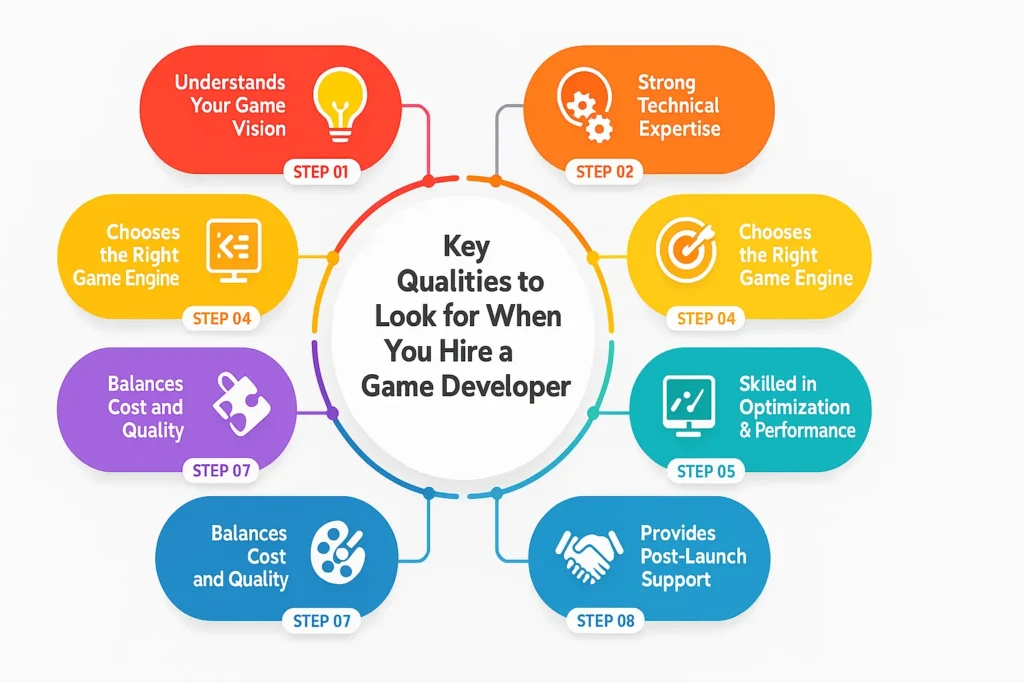
When you are about to approach a game developer, consider a combination of creativity, technical ability, and reliability.
This is what makes the difference between average and great developers.
Game Developers Who Understand Your Game Vision
Your developer must reach out to your creative vision. They must be able to visualize what you would like players to see in the world, whether it is a serene sim or an action-packed role-playing game. Ask them to explain to you what your idea is. When they respond to you in the manner that best reflects your thought, then that is a good sign.
Evaluate Technical Expertise Before You Hire a Game Developer
The foundation of good game development is technical skill. Find developers who have worked with engines such as Unity, Unreal Engine, or Godot. They ought to be aware of how to generate physics systems, intertwine animation, and be aware of their memory. When they are able to answer how they can solve a technical problem in simple terms, they indeed know their job.
Always Choose the Right Game Engine for Your Developer
The game engine defines the performance, appearance, and size of your project.
- Unity is fantastic with 2D, mobile, and indie.
- Unreal Engine is used in cinematic imagery and the highest quality of 3D games.
- Godot is easy and fits smaller projects that are open-source.
When you outsource a game developer, ensure that they are especially familiar with the engine that fits the platform and objectives of your game.
Essential Technical Skills for Game Developers
Before you hire an individual, verify that the game developer knows core programming languages and frameworks: Instrument before you hire an individual.
- C++ and C# for Unity and Unreal
- Scripting languages, Python and JavaScript tools.
- Git or version control system.
- Shaders, APIs, and AI logic Experience.
These capabilities guarantee the smooth running of your game, the capacity to scale, and the ease of adapting to the changes.
Performance Optimization and Cross-Platform Compatibility
A great game can be destroyed because of performance concerns. The game developer is a professional who is aware of how to optimize the code, minimize load time, and eliminate overheating or crashes. They also know how to do cross-platform development, have your game running flawlessly on iOS, Android, PC, and console without compromise.
Creativity and UX Skills Every Game Developer Must Have
Noble games are not only functional, but they are also correct. Your game developer needs to be a designer with an eye to game pace, design, and user experience. The game developer who enjoys playing regularly will inherently know what makes the players remain active and what frustrates them.
How to Balance Cost and Quality When Hiring Game Developers
Cost is important and however, do not allow it to be your only filter. PayScale estimates annual income to be approximately 95,000 USD on average in the U.S, and in Europe or Asia, the expense is reduced by 40-60 percent when the particular game developer is outsourced.
Never forget to consider experience and quality of communication to hourly rates; the cheapest cost may be met with rework in the future.
Ongoing Support and Maintenance After You Hire a Game Developer
Once it is launched, patches, updates, and additions should be expected. Select a developer team or corporation that will provide the after-sales services, like support after launching, bug fixing, and performance tuning. A developer that remains post-release is value-added long-term to your project, and it keeps your players content.
Suggested Read: https://mangomango.io/unity-vs-unreal-which-game-engine-is-best-for-beginners/
Cost to Hire a Game Developer
To have an idea of the cost of hiring a game developer, it is good to know what it actually costs to have one before you embark on the next project.
Prices are based on the proficiency, geography, and the difficulty of your game.
A basic mobile application would be as cheap as several thousand dollars, whereas the luxurious multiplayer or 3D game on the console can be as costly as half a million or more.
Knowing the price early will assist you in budgeting your plan, and meanwhile, avoiding surprises in the future.
Average Hourly Rate for Game Developers by Region
| Region | Average Hourly Rate (USD) | Typical Project Type |
| North America | $60 – $120/hour | AAA titles, console games, complex mobile apps |
| Europe | $40 – $80/hour | Mid-sized 2D/3D games, cross-platform apps |
| Asia (India, Pakistan, Philippines) | $20 – $50/hour | Indie projects, prototypes, mobile games |
| South America & Eastern Europe | $25 – $60/hour | Scalable mobile or web-based games |
A Hybrid model, which employs a local project lead and has remote programmers, will save up to 40 percent without compromising quality.
Hidden Costs When You Hire Game Developers
In addition to the hourly expense, there are several unseen expenses in your budget:
- Software licensing: Unity Pro, Unreal Engine software, making connections, and three-dimensional modelling software.
- Art & assets: Designers, sound engineers, and UI artists usually charge individually.
- Testing & QA: The games require constant bug tests on different devices and versions.
- Publishing costs: Both Google Play and Apple App Store have per-submission fees.
- Post-launch patches: Patches after launch are also a part of the overall cost.
Whenever you contract a game developer, request that they provide a breakdown of costs in detail to have a forecast of all expenses in advance.
Where to Find Game Developers for Hiring?
When you have already defined your budget, the next question is not so complicated: where can you find the best game developers to be hired?
These are the top five choices that have been proven and trusted.
Freelance Platforms to Hire Game Developers
Platforms such as Upwork, Toptal, Fiverr, and Freelancer.com will match you with skilled game developers. One can sort candidates by engine (Unity, Unreal, Godot), hourly rate, and location. They should never employ anyone without looking at their portfolio and client reviews.
Outsourcing Companies for Game Development
In case you require a complete team, including designers and animators, and testers, then outsourcing is preferable. Companies such as Mangomango, Cubix, iLogos, and Virtuos specialize in providing end-to-end game development services. They cover the whole process from concept to launch, which makes the working process smooth and professional.
Game Development Communities and Forums
Game development forums like GameDev.net, Unity forum, and Reddit’s r/gamedev are highly probable to meet enthusiastic indies. You will be able to post your project information, discuss it there, and meet those who really breathe and live games.
LinkedIn and Social Media Platforms to Hire Developers
LinkedIn is a good platform to recruit a game developer with proven experience. Apply filters such as Unity Developer, Game Programmer, or Unreal Engine specialist. Twitter (X) and Discord cannot be overlooked, as many indie developers share the work they do and are willing to collaborate.
Game Development Events and Hackathons
Beautiful places to network, such as Game Developers Conference (GDC), IndieCade, and local Hackathons, are great places to connect. You will be introduced to creative people, unknown talent, and even have developers making prototypes right before your eyes. Face-to-face meetings with developers also allow you to gauge passion and communication, which make long-term success possible.
Types of Game Developers You Can Hire
Before you need to hire a game developer, it is beneficial to understand the key types of talent that exist. They are used to serve a different type of project and level of budget.
| Type | Best For | Strengths |
| Indie Game Developers | Small, creative projects | Agile, budget-friendly, highly collaborative |
| AAA Game Developers | Large-scale, high-end games | Deep expertise, advanced graphics, robust testing |
| Mobile Game Developers | iOS & Android titles | Cross-device optimization, monetization strategies |
| Console & PC Developers | High-performance games | Realistic 3D graphics, multiplayer system integration |
By selecting the appropriate kind of developer, you will rest assured that your project will match up with the ideal competency, time, and platform considerations.
Steps for Hiring a Game Developer
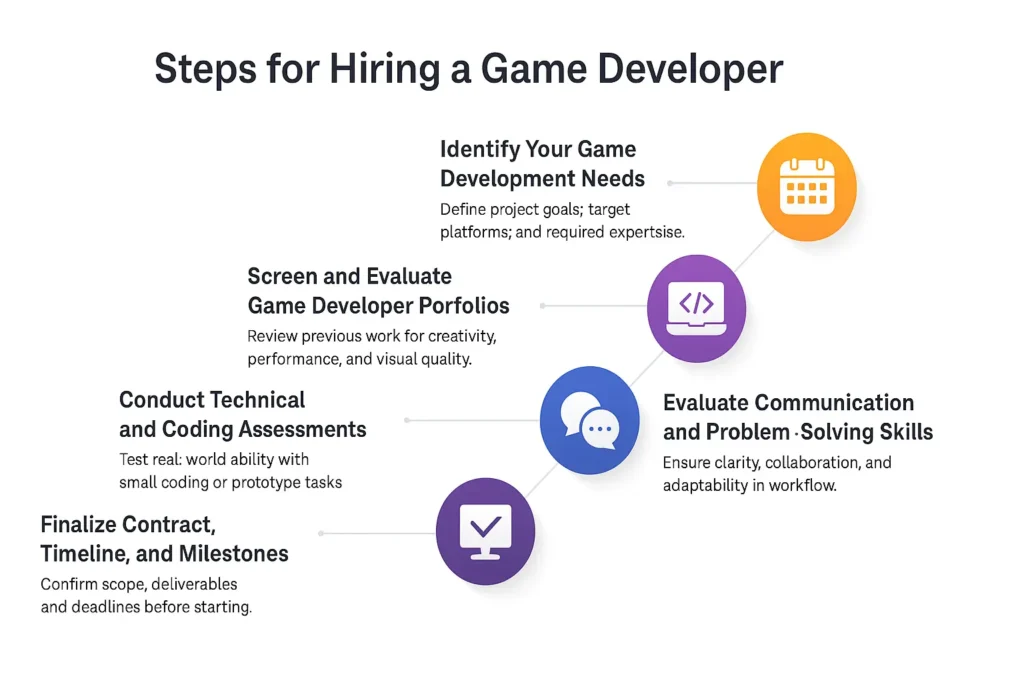
This may seem daunting when hiring a game developer, but it does not have to be the case. The process, correctly in place, can help you recognize talent fast that matches your creative vision, technical demands, and budget. These are the main steps that should be followed in order to simplify and streamline the hiring process.
Identify Your Game Development Needs
The first thing that you can do before you contract a game developer is to clarify what you want to develop. Do you even want to create a 2D mobile puzzle, a 3D console adventure, or do you want to create a virtual-reality thing? Tell the audience what your game is all about, what its genre is, and how it works. It is so much easier to reduce to candidates who will be right for your project once you clearly know your needs in terms of the necessary expertise and experience.
Screen and Evaluate Game Developer Portfolios
A portfolio speaks volumes about a developer, like a resume will never do. Examine prior similar projects regarding your vision. Keep watch on the quality of the game, fluid gameplay, and creativity in content or graphics. Inasmuch as they could, they tested their published demos or live builds. Usually, a good portfolio is an easy indicator that a developer will do what he/she is promising.
Conduct Technical and Coding Assessments
It is prudent to have them go through a little technical test before you engage them to develop your game. Essentially, give them a simple prototype, mini-game, or sample for an idea of yours and have them build it. This demonstrates their mental process and organization of code and problem-solving of technical problems. A single test project, even a short one, can tell how they handled performance, optimization and creativity, constraints, and all.
Evaluate Communication and Problem-Solving Skills
The development of the games hardly moves in a progressive order; features are added, bugs are introduced, and priorities are changed. This is the reason why communication and adaptability are as important as coding. When interviewing the developers, pay attention to the clarity with which they exemplify their thoughts and react to the modifications. The list of developers that listen, ask clarifying questions, and remain calm when there is pressure usually consists of the individuals who provide consistent and high-quality deliverables.
Finalize Contract, Timeline, and Milestones
After locating the right manager, get the partnership through an agreed contract. Append deliverables, payment, intellectual property, and revision policies. Divide the project into milestones (prototype, alpha, beta, and final release) such that the progress can be observed openly. Detailed contracts help to minimize confusion and hold everyone to time limits.
How to Manage Remote Game Developers?
Remote developers are the new reality in game development. It is all about integrating structure, trust, and regular communication. This is the way to handle your virtual team.
Use Project Management Tools for Game Development Teams
It is not difficult to delegate duties, keep track of deadlines, and progress at project-management websites such as ClickUp, Jira, and Trello. Such tools assist in maintaining centralized feedback, asset sharing, and visibility throughout all development phases.
Set Clear Communication Channels for Remote Developers
Select one primary communication channel like Slack, Discord, or Zoom, where you will receive updates daily and be able to fix problems within a day. Create expectations regarding response so that no one feels like an outsider. Frequent video conferences are used to make collaboration more humanized and ensure that the design, code, and art teams align more smoothly.
Establish Milestones and Deadlines for Game Projects
Break the project into small phases that have a time limit. A goal and review meeting should be identified on each milestone. This structure ensures that the whole team is aligned and no bottlenecks occur, particularly when the time zones are working.
Provide Regular Feedback to Remote Game Developers
Remote teamwork requires constructive criticism. Reviewing often, featuring what is going well, and coming out with straightforward recommendations on how to make things better. Constant feedback improves quality as well as confidence and interaction. When the developers are supported and informed, they have a much higher likelihood of performing excellent work on time.
Game Development Technologies to Consider Before Hiring
The appropriate tools and technologies will make the difference between how easy, scalable, and beautiful the game can be. Finalize a developer by ensuring that they are knowledgeable in the following before employment:
- Game Engine Game Engines: Unity ( 2D/ mobile ), Unreal Engine ( AAA/ 3D ), Godot ( indie/ open-source ).
- 3D Power Tools: 3ds Max, Autodesk Maya, and Blender.
- Multiplayer Systems and Backend Systems: Photon, Mirror, PlayFab, Firebase.
- Version Control: Git, Perforce
- Animation Programs: Spine, Adobe Animator, and Substance Painter.
Incidentally, even your developer has a reason why he or she favors this or that engine/tool. The kind of solution they can give will show experience and the style of solving problems.
How to Write an Effective Game Developer Job Description?
An application that is precisely stated and descriptive appeals to the successful developers at a quicker rate. When creating yours, include:
- Project Synopsis: Explain the idea of the game, its genre, and platform.
- Core Responsibilities: Coding, gameplay, debugging, or integration of assets.
- Android Skills needed: Name concrete engines, programming languages, or frameworks.
- Level of experience: Junior, mid-level, or senior developer.
- Soft Skills: Communication, co-operative flexibility, and inventiveness.
- Timeline and Budget: Who, when, and how.
Be open and explicit. This will save time on your part as well as the applicants. Clear, developed persons value clarity, and will most likely be willing to apply to a job description where you exhibit an organization of the job and a firm, creative vision.
Best Interview Questions to Ask When Hiring Game Developers
The most effective opportunity to learn how a game developer thinks, creates, and solves problems is by interviewing him or her. The right questions assist in not just discovering technical dexterity, but also ingenuity and the method of communication. The following are intelligent questions to be asked:
What are your most used tools/engines when developing games, and why?
This indicates that they are acquainted with industry-level engines such as Unity, Unreal, or Godot.
What is your approach to optimization of performance in a game?
You will get to know how they comprehend memory management, frame rates, and lag prevention.
What is the simplest form of a game loop?
It is a basic but eye-opening question; it checks the basics of programming skills.
What is your knowledge about new technologies and trends in game development?
Great developers are lifelong learners who are flexible to changing tools and the behavior of players.
Explain a technical issue that occurred to you and your response.
This question reveals their process of problem-solving and their strength.
What is your attitude to collaboration and working remotely?
Having a large number of developers working remotely, communication skills become as important as code.
A combination of behavioral and technical questions should be used. It is not merely a person whom you are recruiting to code, but one with whom you will co-create your vision.
Benefits of Hiring Professional Game Developers
Outsourcing a professional game developer gives your project a touch of organization, experience, and tranquility. You do not have to go through trial and error, but rather have a proven process for how to go about making a concept into a launch. Some key benefits include:
- Reduced time-to-market: Experts can deal with an effective workflow, minimizing delays.
- Good performance: They know how to optimize and test performance to promote a good game.
- Premium tools: Premium tools are used by experienced developers, and they comprise licensed engines, plug-ins, and frameworks.
- Post-launch maintenance: Maintenance and post-release updates are in the professional teams.
- Creative innovation: A great developer is not a follower, but he assists in polishing your concept until players are willing to use it.
Consulting professionals can also help your game to have greater success in a saturated market. Millions of titles are put out every year, so it is quality that will make yours shine.
Common Pitfalls to Avoid When You Hire a Game Developer
Even well-experienced studios fail to make the right hiring decisions. The most common of them are:
- Looking at cost alone: Hiring the lowest-priced developer will hinder downstream costs in terms of a re-write or low quality.
- Missing technical tests: No polished portfolio can always indicate actual talent; practical tests will.
- Bad contracts: No specific milestones/no specific revision boundaries, and no specific delivery time, so it is likely to experience scope creep.
- Avoiding support after the release: Games require updates, patches, as well as bug fixing. The developer should always provide maintenance after release.
These traps can be avoided to keep your schedule, budget, and the general quality within the mainframe.
Are you willing to launch your game concept? Let us talk today and create something great.
Contact Us!
Conclusion
Hiring a game developer is among the most significant choices in the process of bringing your game idea to life. The appropriate developer can transform your dream into a real, playable one that gamers can get engaged with and is faultlessly playable. Timing is everything; inquire about the correct questions, and you must value ability, innovation, and communication over price. A game with a perfect match will not simply take off; it will soar.
Frequently Asked Questions (FAQs) About Hiring a Game Developer
What skills should I look for when I hire a game developer?
Search professional competencies in the field of programming, experience in using Unity or Unreal Engine, the ability to solve problems, and creativity.
How much does it cost to hire a game developer?
The rates are commonly between $20-$120 per hour depending on the region, experience and the extent of the project.
Where can I find reliable game developers?
Try Upwork, Toptal or professional game studios that specialize in the responsible development of full-cycles.
What’s the difference between a game designer and a game developer?
A designer will map out the concept, mechanics, and visuals and a developer will code and develop the functionality of the game.
How can I ensure quality when outsourcing game development?
It is better to make milestones, ask to make regular builds, test early prototypes, and keep the communication open in the project.